


November 2025
September 2025
August 2025
July 2025
June 2025
January 2025
November 2024
September 2024
July 2024
June 2024
May 2024
April 2024
March 2024
January 2024
December 2023
November 2023
October 2023
July 2023
June 2023
May 2023
March 2023
January 2023
October 2022
May 2022
March 2022
January 2022
December 2021
November 2021
October 2021
April 2021
February 2021
December 2020
October 2020
August 2020
July 2020
June 2020
May 2020
April 2020
March 2020
February 2020
January 2020
December 2019
September 2019
June 2019
May 2019
January 2019
November 2018
October 2018
August 2018
July 2018
March 2018
January 2018
December 2017
November 2017
October 2017
September 2017
August 2017
June 2017
MARKETING WEEK, NOV 2025
It’s time to bring back guerrilla marketing
Marketers need to stop playing by the rules and start writing new ones, grounded in cultural relevance, creativity and authenticity.
Remember guerrilla marketing? It’s a phrase that was bandied around a lot about 10 years ago. As social media took off and began to play an even bigger role in people’s lives, brands were looking to grab attention with unexpected approaches.
It’s a perfect means to play to what I enjoy doing the most – understanding what resonates. From Adidas and Diageo to my agency Platform 13, my career has been around trying to align brands with culture and entertainment.
Back then, in fashion, music, sport and art culture, we used creativity that reflected the world we lived in, where knowledge of and respect for cultures was a superpower. We flyposted because we had no out-of-home media budget, did 24-hour flash stores to rid excess stock and did collabs and activities with our friends – the cultural voices of that community – to foster and drive these new and emerging cultures forward.
Politics, media and technology have always shaped culture because it impacts how we behave, think and connect. Fast forward to the mid-2020s and we are at a tipping point: a collision and intersection of all three that’s redefining what it means to build relevance, trust and value as a brand.
Importantly, we are seeing a real time shift in social media; for a while now, social has no longer felt social. It’s become a broadcast channel for its owners’ agendas and audiences are quietly checking out. According to an analysis of the online habits of 250,000 adults in more than 50 countries carried out for the Financial Times by GWI, time spent on social media peaked in 2022 and has since gone into steady decline. People are tired. They crave connection, not sponsored posts. Meaning, not metrics. Relevance, not bought reach.
Organisations are pushing teams to churn out ‘always-on’ AI-generated slop masquerading as efficient creative work. Even AI defines “AI slop” as mass-produced, low-quality digital content that lacks depth, accuracy or effort. The irony writes itself.
I feel like marketers are so focused on the speed and volume of assets, because they think that social-first means lots of social outputs at pace. This year’s Cannes Lions Festival was full of AI sales people touting speed and scale. Unfortunately, while this has been sold in as a measure of success, what they seem to be missing is how audiences are really engaging (or not), both because of the current state of the social industry and how Big Tech drives low reach because platforms want investment.
There is also major distrust building when it comes to what people are seeing online through bought and bot followers, deepfakes, generic content, parasocial relationships and AI slop.
The outcome is that technology and data is being used to define creativity, resonance, and brand building, resulting in a sea of sameness as all our lives become influenced by tech-controlled algorithms.
How boring.
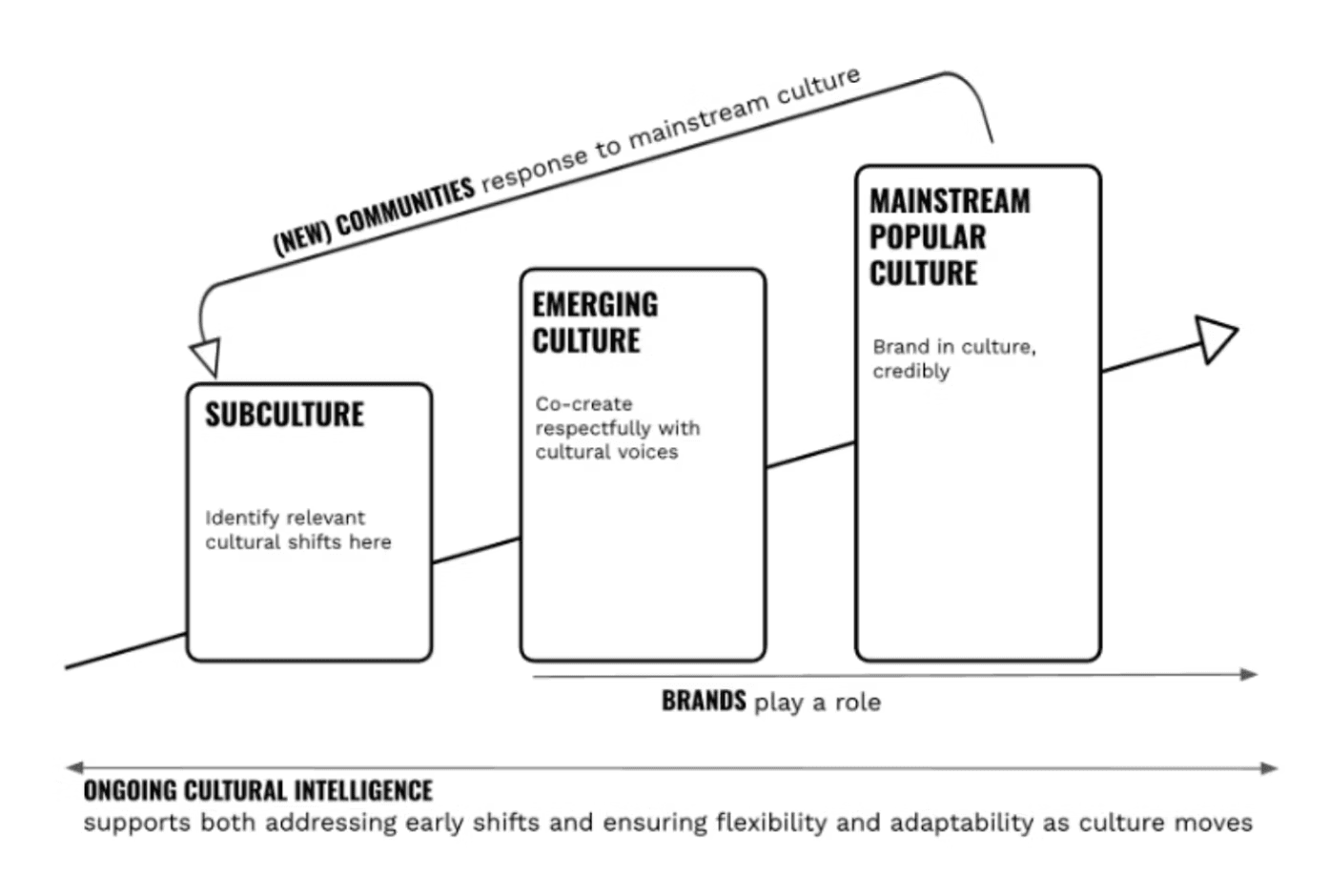
This comes as no surprise to us who read, analyse, gatekeep and work in ‘culture’ because it follows The Cultural Pipeline (pictured above) – a framework I introduce in my book, Culture Led Brands, that explains the stages of fandoms and communities in culture.
By leaning too heavily on efficiency, scale and the next shiny tool, we’ve traded creativity for convenience, losing meaning while audiences have already moved into subcultures and early emerging culture using new ways of connecting. These are usually places where Big Data and the algorithm struggle, because they can only read signals once they reach scale.
As brand people, we need to drive cultural relevance (and no, that does not mean a famous person in your ad or jumping onto a viral ‘trending topic’) to succeed. As the ‘attention economy’ evolves, marketers need to find ways to credibly engage fans and consumers’ consistently beyond that one spike, traditionally achieved through a reach media buy. This means doubling down on the thing that makes your brand unique (I call this a cultural positioning), delivering ownable and original creative activity, no matter the marketing and comms channel.
Done right, this drives brand discovery (and ultimately growth) by doing things that people want to share in the places and spaces they are in. That’s where creativity, craft and cultural value live. That’s how brands earn real resonance and relationships, not just impressions.
A culturally relevant brand refers to a brand state when people engage positively with that brand, work for that brand, defend it, advocate for it and buy it, at any time, not only during the paid campaign cycle. They will do this because it deeply connects with them within the context of what is happening in their own, and the wider world, meeting them how and where they are, credibly.
Best in class for me is the recent partnership between Nike and the skate brand Palace, which joined forces to open Manor Place, a free, public hub for sport, creativity and community in South London. A win for everyone, including the regeneration of a space built in 1895, and especially for Nike, which is on a real comeback following some difficult years.
On the other side of the spectrum, any brand chasing the myth of ‘virality’ by jumping onto a trending topic without that being its strategy or the topic making sense for the brand can seem inauthentic, old fashioned and cringe.
The era of culture led brands will reward those that break the formula to cut through: 2026 could look like if-you-know-you-know gatherings where phones are banned, where taste, depth of topics and curation once again become a differentiator, where ads become long form mini dramas, where cohesive transmedia storytelling is proudly made by humans not machines, and where adding value to, not just extracting from culture to build that community and fandom is the only way forward. We can do this by making true brand cultural relevance a business growth driver, using it as both an objective and an outcome.
Back in the day, marketers led the charge: shaping brand stories and driving audience engagement that mattered. Now too many have become beholden to Big Tech chasing a reactive loop of buying reach, chasing trending topics and navigating ever-changing algorithms and AI updates that are hard to keep up with.
It’s time for marketers to stop playing by the rules and start writing new ones, grounded in cultural relevance, creativity and authenticity.
The definition of the role of marketing, which I agree with, was articulated well by Seth Matlins on the Uncensored CMO podcast: “Marketing’s job remains fundamentally about capturing attention and influencing attitudes and behaviours such that you drive sustainable profitable growth. It is unchanging.” The tools and channels might change but the role won’t.
And in this era of culture-led brands, it may just be time to revisit guerrilla marketing mindsets, evolved and fit for purpose for the 21st century.